Executive Summary
- Who this is for: CIOs, CTOs, Enterprise Architects, Solution Architects, Engineering Leaders
- Problem it solves: Persistent confusion between architecture and design in software and technology organizations
- Key outcome: Clear structural separation between decision-making architecture and implementation design
- Time to implement clarity: 30 days
- Business impact: Faster decision cycles, reduced architectural debates, stronger system stability
The Conversation That Happens in Almost Every Organization
In many architecture reviews, someone eventually says:
"But isn’t that just design?"
Or the opposite happens:
Developers call something architecture that is actually implementation detail.
This confusion is extremely common.
And it causes real problems.
Architecture discussions become endless.
Design decisions escalate unnecessarily.
Governance slows down delivery.
The root issue is simple:
Most organizations do not clearly distinguish architecture from design.
But they solve completely different problems.
The Core Difference
The difference can be summarized in one sentence:
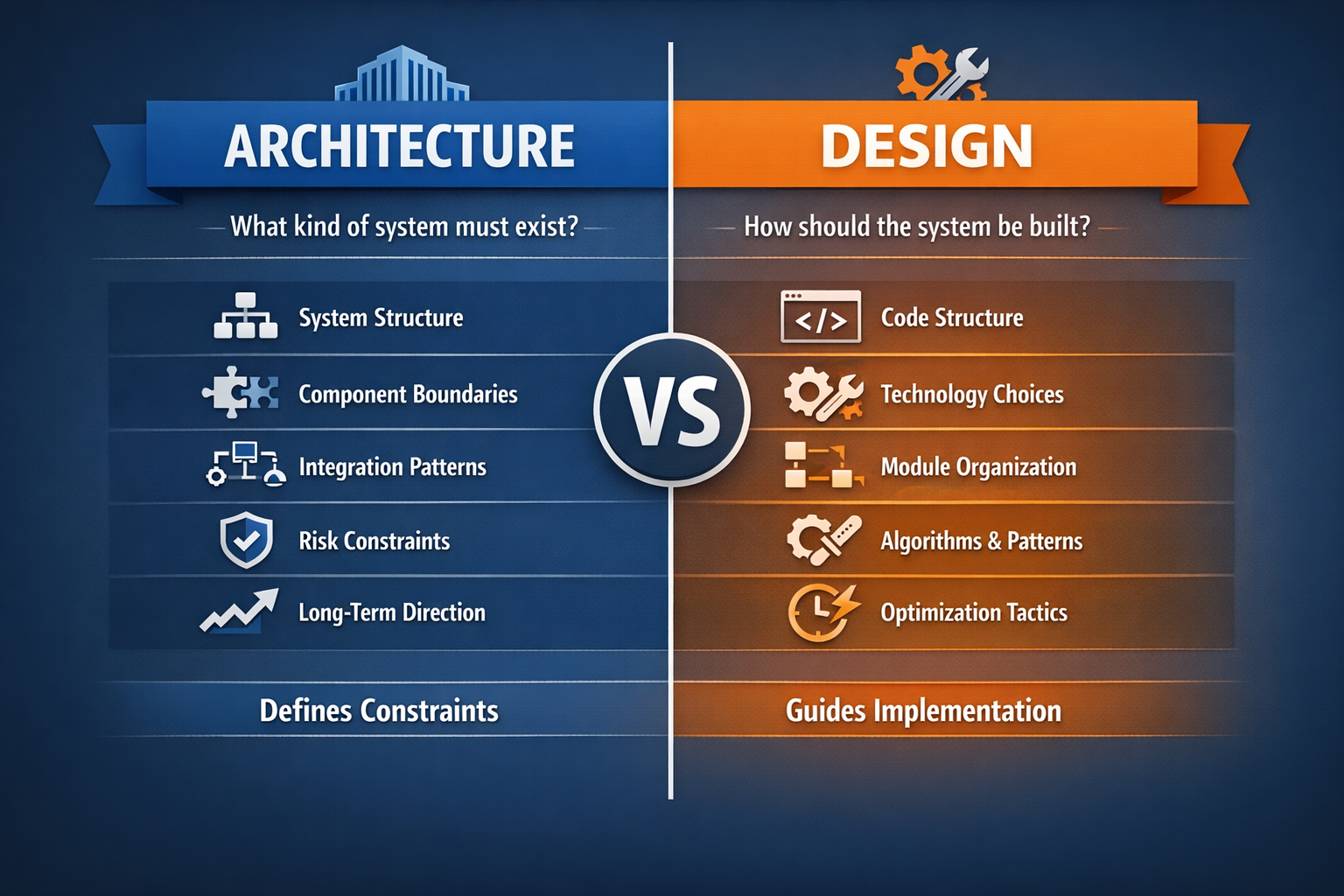
Architecture defines structure and constraints.
Design defines implementation within those constraints.
Architecture decides what kind of system must exist.
Design decides how that system is built.
Both are essential.
But they operate at different levels of responsibility.
Architecture — The Structural Layer
Architecture defines the fundamental structure of the system.
It answers questions like:
- What capabilities must exist?
- How are major components separated?
- What integration patterns are allowed?
- Where are data ownership boundaries?
- What technology constraints exist?
- What risks must be controlled?
Architecture creates the environment in which design operates.
It establishes constraints that prevent structural instability.
- Long-term structural decisions
- Cross-system impact
- Alignment with enterprise strategy
- Risk and scalability considerations
- Technology posture definition
Architecture decisions are difficult to reverse.
They shape the system's evolution path.
Design — The Implementation Layer
Design operates within the architectural boundaries.
It answers questions like:
- How should a service be implemented?
- Which framework should be used?
- How should classes and modules be structured?
- How should APIs be implemented?
- What coding patterns should be applied?
Design focuses on execution quality.
Characteristics of Design
- Implementation detail
- Localized impact
- Faster iteration cycles
- Code-level decisions
- Optimization for maintainability
Design decisions can change frequently.
Architecture decisions should not.
A Simple Everyday Analogy
Consider building a house.
Architecture decides:
- The number of floors
- Structural layout
- Load-bearing walls
- Electrical and plumbing routing
Design decides:
- Kitchen layout
- Cabinet style
- Lighting fixtures
- Furniture placement
If design tries to redefine architecture, the structure breaks.
If architecture controls every design choice, progress stops.
Balance is required.
The Organizational Problem
When architecture and design are confused, three patterns appear.
1. Architecture Boards Review Design Details
Architecture review meetings debate:
- API parameter naming
- Framework selection
- Code structure
This slows delivery.
Architecture governance becomes bureaucratic.
2. Engineering Teams Redefine Architecture
Developers make decisions like:
- Introducing new integration patterns
- Redefining service boundaries
- Changing platform strategy
These are architectural decisions.
But they occur without architectural accountability.
Result: structural drift.
3. Everything Becomes “Architecture”
The term architecture becomes overloaded.
Every technical choice is labeled architectural.
This dilutes real architectural authority.
Governance loses focus.
The Structural Separation Model
Healthy organizations separate three layers of decision making.
| Decision Layer | Focus | Typical Owner |
|---|---|---|
| Architecture | System structure and constraints | Enterprise / Solution Architects |
| Design | Implementation approach within constraints | Technical Architects / Engineers |
| Development | Code implementation | Engineering teams |
Architecture protects structure.
Design enables implementation.
Development delivers functionality.
Each layer has a distinct responsibility.
Why This Confusion Persists
Three reasons explain why organizations repeatedly mix architecture and design.
1. Lack of Decision Altitude Clarity
Many teams do not define which decisions belong at which level.
Architecture becomes a vague concept.
2. Governance Without Clear Boundaries
Architecture review boards often review anything technical.
Without defined scope, governance expands endlessly.
3. Cultural Overuse of the Word "Architecture"
The industry uses the word architecture for everything:
- Software architecture
- Data architecture
- API architecture
- Microservice architecture
- UI architecture
The result is semantic inflation.
Real architecture becomes harder to identify.
The Governance Principle
Architecture should control structural decisions that are hard to reverse.
Design should control implementation decisions that evolve frequently.
If architecture governs everything:
Delivery slows.
If design governs structure:
Systems become unstable.
The balance lies in clear decision boundaries.
Implementation Guide (30 Days)
Phase 1: Decision Classification (Weeks 1–2)
List recurring technical decisions and classify them:
- Architectural
- Design
- Implementation
Identify where confusion currently exists.
Deliverable: Decision Classification Map
Phase 2: Governance Alignment (Weeks 3–4)
Define clear governance boundaries:
Architecture reviews should focus on:
- Structural system decisions
- Integration patterns
- Platform strategy
- Data ownership boundaries
Design and implementation should remain within engineering teams.
Deliverable: Architecture vs Design Governance Guidelines
Evidence from Practice
Organizations that separate architecture and design experience:
- Faster delivery cycles
- Clearer governance meetings
- Reduced architectural escalation
- More stable platform evolution
Organizations that blur the boundary experience:
- Endless architecture debates
- Engineering frustration
- Structural inconsistency
- Governance fatigue
Clarity accelerates execution.
Action Plan
This week, ask your teams three questions:
- Which decisions are architectural?
- Which decisions are design?
- Who owns each category?
If those answers vary across teams,
architecture governance is already unstable.
Final Thought
Architecture and design are not competing disciplines.
They are complementary layers.
Architecture defines the system's structural integrity.
Design ensures the system is implemented effectively.
Confusing them creates unnecessary friction.
Separating them creates execution clarity.
Technology organizations move faster when structure and implementation are clearly distinguished.
Separate Structural Decisions from Implementation Debates
If architecture reviews frequently debate coding patterns…
if engineers are redefining integration patterns…
or if governance feels heavier than delivery requires —
you may not have an architecture capability problem.
You may have a decision boundary problem.
In a focused 30-minute Architecture Governance Diagnostic, we will:
- Identify where architecture and design decisions are blurred
- Clarify structural vs implementation authority
- Reduce governance friction without weakening architectural control
- Define practical decision boundaries aligned to delivery speed
→ Book an Architecture Governance Session
or
Architecture protects structure.
Design enables execution.
Execution accelerates when both are clearly separated.